It’s Heartbreaking When You Have to Say No

If you’ve been reading this blog, you know that I’ve been on a mission to get one or another of my books published for a few years now. I’ve received rejection upon rejection from literary agents. Some of them were encouraging. The last agent to reject Women Like Us wrote, “I was highly entertained reading your pitch and sample pages. You have a great comedic voice and I thought your narrator was charming.” I enjoy hearing that. It honestly makes my day, every time. From what I hear, literary agents are unbelievably busy people whose inboxes are jammed with so many query letters they need to hire help just to open each one and hit “send” on the form rejection. So if one of them liked my writing enough to send me a personal note about specific things she enjoyed in my book, I call that a win.

Of course, most of my rejections came as form letters. I’ve got close to two hundred of those. You’d think this would mire me in a deep depression, but like I wrote here, I’ve learned not to let the rejections get to me. I see, “RE: Query: WOMEN LIKE US” in the subject line and my first thought is, “Oh look, I’ve got another form rejection.”

Sure, there’s hope too. Just before I open the email, my thoughts jump to, “Maybe this one will be different. Maybe she wants sample pages. Maybe she wants a full manuscript. It’s still possible!” But I banish all expectations from my mind before I click that email open. I don’t want to get my hopes up only to have them crushed. That way, when I read, “Thank you for querying me with your project. Unfortunately…” I can go, “OK, just what I thought. No big deal.”

So imagine my surprise when one day, I opened one of these emails to read lines like, “A great novel…once I started I could not stop…acquisition discussion phase…set up a conference call.” This email was from a publisher, not an agent, and it was certainly not a rejection. This publisher wanted my book.

I was over the moon happy. I told everyone I knew. Thoughts about what it might be like to be a published author pre-occupied me for days until that conference call finally came along and I got a chance to talk to the publisher who fell in love with my book. This was the best conversation I’ve ever had in my life. I have never spoken to anybody who gushed about my writing more, including my mom. (Sorry mom. Nobody is more surprised than I am. You are still the Queen of Gushing.)

I was a little skeptical, because this was an indie publisher without much of a history. I talked to some friends who are published and asked for their advice before the call, and I wrote down a list of “must know” questions to make sure I was fully informed. Here’s the list, if you’re curious:

1. Can you tell me some sample titles that you’ve published? (So I could later look them up on Amazon.)

2. What is your experience in publishing?

3. What is your editing process?

4. How will I be compensated? Do you expect me to have any financial obligations in publishing or marketing this book?

5. What is your marketing plan for my book? Can you give me some examples?

I also asked her a couple of specific questions about the plot of my book, just to make sure she’d actually read it. I didn’t really doubt that she had, but I’ve heard horror stories about unknown publishers acquiring any books they can get their hands on with no intention of ever actually selling them. I wasn’t obvious with the plot questions, and I framed them so it sounded like I wanted her opinion on certain plot points. It would be rude (and a little desperate-sounding) to come out and say, “Have you really read this book?”

Well let me tell you, she’d really read the book. And she loved it. She told me her favorite parts, which qualities of my characters spoke to her, which parts surprised her and made her laugh out loud, how much she loved the manner in which my characters accomplished their goals. She made me feel like a brilliant writer. At the end of our call, she said, “Whatever you choose, whether you publish with us or not, you’ve got a fan for life. I will read whatever you put out there.”

Wow. I defy you to find one writer who wouldn’t be thrilled to hear those words.

She also answered all of my other questions satisfactorily. I really thought I was on the verge of signing a publishing contract. Then came the contract itself. I decided that, since I wasn’t represented by an agent, I should have an attorney review it. The publisher and her contracts manager were very supportive of this idea. They said, “We don’t want you to sign anything you’re not comfortable with. Getting an attorney to review it is the perfect way to ensure that everything in the contract is in your best interest.”

So I got an attorney referral from my father-in-law (Thanks Ray!) and sent it off. There was nothing inherently wrong with it. They weren’t trying to screw me over or anything. In fact, most of it was boilerplate. But my lawyer did suggest a few changes that, according to him, were to “clarify terms.” Seemed innocent to me. I read over his suggestions, asked him a couple questions to make sure I understood, and sent the amended contract back to the publisher.

Now, all of this took some time. My lawyer had a vacation, the publisher had a conference, there were other books they were working on. So several weeks passed while the contract was going back and forth. During this time, I decided to do something I should’ve done from the beginning. I read some of their other authors.

Some of them seemed very talented. But there were a few whose writing I thought just wasn’t publishable. It was full of awkward sentences, echoes of the same word used way too many times, and verbose passages that could’ve been cut down by half without losing any meaning.

I thought, “If they think this writing is good enough to publish, why are they interested in mine? Do they think my writing is at the same level as these guys?” Then the more devastating realization, “If I publish with these guys, and this is the kind of stuff they’re putting out there, will anyone take me seriously?”

The answer, unfortunately, is probably not. When I ask other published authors to blurb my book, the first thing they’ll do is look up other books put out by the same publisher. If they’re terrible, that author will not want their name associated with them. When my publisher sends my soon-to-be-released manuscript to bloggers and book reviewers who’ve received dozens of poorly written books from these same guys before, they’re likely to never even pick mine up. As far as they know, it’s not worth their time. No matter how much time and effort the publisher puts into marketing my book, if they’ve got a reputation for selling stinkers, the writing community will assume my book should fit into that same category.

Realizing this broke my heart. I didn’t want it to be true. I tried convincing myself it wouldn’t work out that way. My book is good. My writing isn’t clunky and awkward. It’s snappy. Funny. Poignant. I’ve got a great comedic voice, for crying out loud! People will see the difference between my work and theirs, and they’ll love my book. And even if they don’t, even if it doesn’t sell, that’s no big deal. I’ll write more books. I’ll have learned my lesson and I won’t publish with these guys again. My career can move on.

But what if it doesn’t? I’ll never be a first time author more than once. Any agent or publisher who’s interested in one of my future books will first look up the sales figures of my previous books. This is something that could haunt me forever.

Even still, I didn’t want to believe that. I continued to talk to the publisher and negotiate the contract. But a funny thing happened. These people, who had always responded to every email I sent them within a few hours, started getting pretty distant once my lawyer got involved. Even though they’d welcomed his review in the beginning, once they saw his suggestions they started backing off a little. It took them a long time to respond to his last round of suggestions. When they finally got back to me, they said his changes would drastically alter the contract. My lawyer and I were both surprised by this. We thought they were simple, clarifying changes. What was going on here?

Still despite all these red flags, I told them I was willing to continue negotiating with them, and I was confident that we could work out a deal that we were all comfortable with. In other words, “I’ll work with you! Don’t worry!”

After that, their communications with me got even more cagey (and infrequent). I finally had to admit, this publisher is not for me. I’m kind of embarrassed about how long I let it go on, and how much evidence I ignored.

This is not to dis all indie publishers. I love indie publishers. The world would be a much less colorful place without them. And I’m sure there are thousands of writers out there who have had wonderful experiences with them. I’m just saying I’m relieved that I didn’t sign that contract.

I finally sent them my break up email last week. I told them that I enjoyed talking with them about my book, and I was grateful for their enthusiasm for my writing, but in the end, we weren’t a good fit. It’s kind of ironic to be on the sending end of an email like that. It also sucks.

Do you have any stories to share about heart break in publishing? Or success stories from working with an indie publisher? I’d love to hear those too. It would make me feel more optimistic about the world in general to hear some good news. I LOVE hearing from you!

‘Til the Shoutin’s Over and They Gather up the Singin’ Books: Writing in Character Voice

I like to write my novels in first person character voice. (Some people call it writing in dialect.) I do it for a few reasons. One, I enjoy reading novels written this way. Two, I think I’m pretty good at it. And three, I absolutely LOVE distinctive human voices, particularly those of the American South.

Writing this way is a challenge. For one thing, I haven’t been to all the places that I’ve set stories in. Right now, I’m writing a novel called Freedom City set in the Ozark Mountains region of Arkansas. Most of my characters are not from the Ozarks. They’re transplants from other parts of the south.

But one character, Pearly, is a ninety-five year old great-grandmother, born and raised in the Ozarks. She’s not the protagonist, but she’s an important character with several point of view chapters. And I (confession!) have never been to the Ozarks.

So what does a novelist such as myself do? I can’t afford to take time off from my life and spend a month with the Arkansas hill folk. And I don’t know anyone from that part of the country with whom I can just sit and have regular conversations, or eavesdrop on. (Incidentally, eavesdropping and conversating are ordinarily my two best tools in learning how to write like others speak.) My soon-to-be brother-in-law is from Missouri, which also encompasses a large portion of the Ozarks, but the one time I tried to get him to spend the day talking like a backwoods hillman, he kept coming back to his regular speaking voice. (What’s up with that, Ryan? ;) )

The answer, for me anyway, is read, read, READ! I’ve read every novel set in the Ozarks that I can find. Unfortunately, there aren’t many of these. The only one that I actually enjoyed was Winter’s Bone by Daniel Woodrell. (Read it if you can stomach a lot of darkness and violence.) I also checked out all of the Arkansas travel books owned by my local library. (If you’re wondering, that’s one. One Arkansas travel book in the whole library. Alabama had like five. Don’t people travel to Arkansas?)

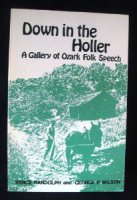
So, imagine my delight when I came across this hunk of pure Ozarkian gold.

Image

The book is Down in the Holler: A Gallery of Ozark Folk Speech, by Vance Randolph. This thing’s got chapters like, “Backwoods Grammar,” “Ozark Pronunciation,” “Unusual Words and Meanings,” “Sayings and Wisecracks,” and lots more. I’m telling you, if there were a college course called Ozarkian English 101, this would be the text book. (Can you tell I’m excited to find this book?)

Randolph was not the leading expert on Ozark language and culture, I’m pretty sure he was the only expert. He spent decades living in the hill country, traveling all over the various towns in both Arkansas and Missouri, and just learning about the people. Then he wrote lots of books. I’ve already read his book, Ozark Superstitions (which is available for free download here), so I suppose I should’ve thought to look for this one sooner. But holy cow, it’s good stuff.

And here’s why writing in character voice is so tough. Aside from learning how the people in your novel’s little part of the world might talk, you must also find a way to convey their speech in writing, making it sound as authentic as possible, but without getting so dialecty that people can’t read it. (Or worse, they can read it, but they can tell you’re trying too hard, and it’s pulling them out of the story.)

This is my biggest problem with Pearly. According to Randolph, Ozarkers mix up their vowel sounds and their subject-verb agreement. And they use a vocabulary not likely to be found in most of the rest of the country. (Have you ever heard of a gollywhopper? A goose drownder? A goozle? What about government socks? These are just some of the G’s!)

In other words. I. Love. How these people. Talk. And I’m going to have sooo much fun writing my character.

So here’s a snippet of my first attempt at one of Pearly’s chapters, written in (hopefully believable) Ozark voice. What do you think?

Christine an’ her husband thinks I’m here fer me. Thinks I’m a-ridin’ along. Lettin’ my grand-youngin’ take care of her helpless, susy Nanny, who don’t talk none. Who can’t do nothin’ to feed herself vittles or wipe her own behind.

An’ let me ask you. When’s the last time you seen me a-needin’ my behind wiped? Christine and that man can’t seem to remember that. But I was nary a baby the last time mammy took a towel to my butt, an’ I ain’t needed no help with it since.

Let them thinks it. I gots better things to worry me anymore.

Like a-gettin’ this paw paw spread out an’ around. I sprinkles the grinded-up root around up over the perimeter of our property. I wants to lay out broomsticks too, but Christine might would pick them up when she sees. Clay might could miss them. Might could trip. Wouldn’t that be an awful shame? If only I could know fer sure he’d be the fist one out’n the house.

Fer now the paw paw’ll have to do. That an’ the crosses. I scratches them in over the dirt around about the property, an’ hangs some real ones from up there on the tree an’ bushes. I skips the branch a-stretchin’ up on over Chrisine’s Jesus. He can fend for hisself.

It’s a first draft, but I like it so far. (OK, I’ve been over it more than once. I’d NEVER show you a real first draft.) Bear in mind, Pearly only has about seven or eight chapters in the book, so most of it isn’t this thick. I’m hoping it’s just enough.

Do you have any ideas for improving dialect in your writing? Please let me know in the comments section below. I LOVE hearing from you!

I’m a big, blubbering, scaredy-cat baby…and my kids are getting there.

Image

With Halloween approaching, I thought it a good time to explore the subject of fear. As in, that immobilizing tightness I get in my chest in response to completely rational, empirically terrifying things, like the porch light coming on.

My oh-so-patient husband (who will be fitted for his shining armor on our next anniversary), valiantly checks all the doors and windows for me whenever something spooks me. (Did you see those headlights outside? I swear someone stopped their car in our driveway. Who would do that at eleven o’clock? And why are they playing music? That sounds like axe murderer music, honey. Don’t you hear that?)

And if he’s out of town, forget me sleeping. I usually don’t go upstairs until at least 1 AM, because, well, upstairs (where I have responsibly tucked my children in for the night) is way scarier than downstairs. And before I finally DO climb into my bed, I check underneath, I check all the closets, the kids’ rooms, and the bathrooms. (Not just behind the shower curtain but under the sink too. You know a psychopath could fit in there if he moved my Comet and Charmin around.)

So yes. I’m a big baby. But let me explain how I got this way. First of all, this is my dad.

Image

You try growing up with that and see if you turn out normal. He doesn’t need to even open his mouth to be menacing. When I was growing up, he liked to torture me and my siblings by scaring the living bejeezus out of us. Example. He used to lie down on the couch and say, “I’m going to take a little nap. Just wake me up if I turn into a monster.” He’d lie there, fake-sleeping for a minute, then suddenly pop up with one eye open and his face contorted into this grotesque expression that could only belong to the living dead.

“Oh, that’s not so scary,” you say. “Quit being a baby and grow up!”

I was starting you off easy. He also had this witch mask that he kept in the attic…most of the time. I don’t remember the exact details of this mask’s appearance. I think it’s mutated in my memory a bit, but here’s the description to the best of my ability. It had green, frizzy, goat-like hair that stuck out from its head in chunks. Wrinkly, sagging skin that I’m pretty sure he melted off a burn victim. A long, big-nostriled nose complete with warts. And the wide, tiny-pupilled eyes normally reserved for serial killers and possessed people.

I didn’t like this mask.

Every once in a while-not often, but only once it had been long enough that I’d almost forgotten the last time and begun to feel safe again-he’d pull out the mask. He wouldn’t just come out and scare me with it like a (partially) normal person. He’d go outside and wait for my attention to get absorbed in something innocent, like a book or a tv show. Then, with the mask on, he’d lightly tap the window. The sound could’ve been nothing. Maybe the wind blowing a tree branch. A small animal, perhaps. If I didn’t notice, he’d tap again. Not louder. Still the same, quiet, innocent sound that could’ve been anything, so that when I turned to see “What is that behind me?”, well, you can guess the reaction.

It isn’t entirely his fault that he’s this way. In the Renzi family (my dad’s side) scaring your children is a beloved pastime. I think it may have started with my grandfather. He would dress up like a ghost and terrify my aunts and uncles (and presumably my dad, though I’ve never heard him admit to this).

One of my aunts has been known to hide under her kids’ beds, waiting as long as it took for them to come in and start getting into their pajamas so she could reach out a hand and grab their ankles. My cousins used to go to bed at night begging, “Mom, please don’t scare us tonight.”

My uncle tells the scariest stories I’ve ever heard at a campfire. At our last family camping trip, he had my daughter Emma shouting, “Bad! Bad! I don’t LIKE that story! Stop! You have to stop!” until I carried her out of earshot and reassured her that no bad bears were going to eat her.

But poor Emma. And Sophia and Raymond. Because their mom is a Renzi too.

I do the same, “Wake me up if I turn into a monster” bit that my dad did to me. Plus so, so much more. When Emma and Sophia were toddlers, they were really scared of the Grinch, particularly the song from the cartoon movie. So I sang it. Often. And in a deep, throaty voice that gets them jumping even if I’m saying “I love you” with it.

I’ve been known to put on a dead-eyed, slack-jawed face and amble toward them, arms immobile at my sides, emitting a low groan like a zombie who would love to feast on their brains. And since they’ve gotten into Star Wars, I’ve used this opportunity to impersonate Darth Vader’s loud breathing as I march purposefully toward them. I even downloaded the Imperial March for background music.

My mom shakes her head. “You’re such a Renzi!”

My husband shakes his head. “I hope it’s cozy in Hell!”

And Emma, Sophia, and Raymond? Well, they don’t know it yet, but they’re taking down ideas for terrifying their own kids someday.

Songs That Bug Me

Does anyone else get annoyed when song lyrics don’t make sense?

I love music. So many different styles of music. When it’s a good song, I feel it. Especially when the melody and lyrics come together in perfect compliment, so you can’t help but go, daaaamn. I know exactly what she means! Sing it, girl! My new favorite single is Royals by Lorde. Try listening to that without moving your body.

But seriously. Some of these songs make me wonder if pop stars learn the same English language as the rest of us. Now before you crucify reprimand me for being anti-art (Grammar nazi! It’s a song, not a college essay!), let me say I’m all for artistic expression. I’m always manipulating language to fit my style and voice. I’ve got ten sentence fragments in this blog post alone. (Bragging rights if you can find them all.)

I’m not talking about grammar. Or punctuation. I’m talking about illogical lyrics. Take Cheap Trick’s “The Flame,” for example.

Remember, after the fire, after all the rain,

I will be the flame.

I will be the flaaaaaame!

Is that supposed to be comforting? Why would I want you to be a flame after I just survived a fire? I know it’s supposed to be a metaphor for something, but what?

And how about One Direction’s “What Makes You Beautiful”? (I know, I know. No fair using a boy band. Too easy. But this one really bugs me.)

Baby you light up my world like nobody else.

The way that you flip your hair gets me overwhelmed.

But when you smile at the ground it ain’t hard to tell-

You don’t know-ow-ow,

You don’t know you’re beautiful.

Oh-oh-oh,

That’s what makes you beautiful!

So many issues with this one. Where do I begin? First of all, I know teenage boys aren’t exactly experts on feminine body language, but do you seriously not know that when girls flip their hair or smile at the ground it means they’re flirting? And they don’t even go together. Hair flipping says, “Look at me! I’ve got great hair and I want you to notice me!” And smiling at the ground means, “I want to look coy, but I know that you know that I know you like me.”

But set these guys’ lack of knowledge about girls aside. I suppose I can forgive them for that. What is up with the end of the song? You don’t know you’re beautiful. That’s what makes you beautiful. So low self-esteem is the big turn-on, huh? If that’s the case, why did you just spend three minutes trying to convince her that she’s beautiful? Now that you’ve told her she’s beautiful, does she know it? And if so, does that make her no longer beautiful?

And while we’re on the subject of boy bands, what about “Quit Playing Games with My Heart” by the Backstreet Boys?

Sometimes I wish I could turn back time,

Impossible as it may seem.

So what is it you’re referring to when you say that “it” seems impossible? You probably think it’s turning back time, but to me it sounds like you’re saying the fact that you wish you could turn back time seems impossible. OK. Maybe if I knew you better, and you were the type of guy who never wishes for such things, then I’d think that seemed impossible. But you’d be playing to a pretty small audience there.

But even if I accept that you mean it seems impossible that you could turn back time, it still makes no sense. That doesn’t seem impossible. It is impossible.

And Carly Simon, you’re not getting off here. What’s up with “You’re So Vain”?

You’re so vain.

I bet you think this song is about you.

Hello! This song is about him! You just said like a hundred and ten things about him! Were those just minor points that didn’t speak to your true theme?

Anyway. Sorry to be such a crank this afternoon. I have a cold. When my head clears up I’ll go back to writing about my novels and goofy stuff my kids say.

Are there any songs that bug you because the lyrics are illogical? Let me know in the comments section below. I’d love to hear from you!

Contest Results

Hey everyone! Here are the results of my first ever blog contest.

We had 9 commenters (excluding me), 18 Twitter shares, and 13 Facebook shares, for a total of 40 entries. I’d say that’s pretty good for my first blog event. Thank you everyone who participated. I loved reading all of your comments.

And wouldn’t you know, the winner is none other than the very first participant, Janneke. Congratulations Janneke! I hope you enjoy the book.

Stay tuned. I’ll have more books to give away in the future. Until then, please keep reading and commenting. I love hearing from you!

***UPDATE***

It turns out that Janneke is one of my international followers. And like I stated in the contest rules, if a reader outside the US wins the contest, he or she will receive an Amazon gift card as a prize because shipping the book would be too expensive. Hope you order a great book with your gift card Janneke!

So, since I still want to give this book away, I decided to do a second drawing and give the book to the runner up. This time, the winner is…Marie! (AKA “Mom”)

I swear this wasn’t rigged. Hope you like the book Mom. If you don’t mind, I’ll just give it to you when I see you on Sunday. :)

Thanks again to all of you for playing!

Waiting for The Aha

So here I am, about 8,000 words into my first draft of Freedom City. I started working on this novel a few months ago, but I got stuck. What I’d written so far wasn’t working, so I had to scrap most of it and go back into my outline.

Now, when I say “most of it,” it really wasn’t much. A few thousand words. Losing those words wasn’t painful at all. I’ve lost much more on my first two novels.

After three months of writing Going Home, I realized the voice was all wrong. I think I might’ve scrapped close to 40,000 words. (I’m actually kind of appalled that I can’t remember exactly how many words I scrapped. Those words were my brain children. My severely disabled brain children who needed my love and care. Sorry babies.)

I got about 40,000 words into Women Like Us before I realized I’d started it in the wrong place. I’m pretty sure I cut 30,000 of those words too. That’s three-quarters of what I’d written so far. But hey, I was getting better.

So losing a few thousand words from Freedom City was really no big deal. But here’s where the neurotic wheel in my brain starts spinning. Why haven’t I lost more?

I guess the first obvious answer is that I haven’t written more. But is that it? I already got stuck. I already had to go back into my outline and figure out what the heck I was doing with this novel. That’s the tradition. Shouldn’t this happen at 30 or 40 thousand words? Is everything I’m writing now just kindling for the pyre I’m going to make out of this manuscript before I can really get into it the right way.

I need to stop thinking this way. Because you know what? If I hadn’t written those 30,000 word babies, I’d never have figured out what my book was really about. I wouldn’t have known the right way to write it.

So maybe they weren’t word babies. Maybe they were word parents who selflessly sacrificed themselves to make the rest of the manuscript stronger. It hurt to lose them. Especially in Women Like Us, because I’d written such a marvelous back story for my characters that simply didn’t fit into the novel once I’d figured out which way it was going. Though the words may not physically be there, they did inform the story. I know what happened in Lemon’s and Rayline’s past, even if I did have to chop it out, and that’s what made them the characters they are.

Does your writing process include any maddening but necessary “traditions” like mine? Let me know in the comments section below. I’d love to hear from you!

Contest!!

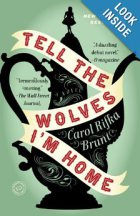
Tell the Wolves

Hey everybody! So I’ve decided to throw my very first blog contest. I’m giving away a signed copy of Tell the Wolves I’m Home by Carol Rifka Brunt.

Here are the rules. Just fill in the blank for this statement in the comments section below: “One problem only kids from my generation would understand is…”

Any response will do. It doesn’t have to be funny or witty, just something that reminds you of your childhood. I don’t even care if it’s your original thought. Go ahead and Google “Problems only 80′s kids would understand.” Doesn’t matter to me! And if you really, truly just can’t think of anything, just leave any comment. Even a, “Hi Nicole!” will work.

I’ll start. One problem only kids from my generation would understand is…having to buy the tape and read the insert before you can figure out the lyrics to your favorite song. You can just Google it now!

So leave a comment (must be on this blog page, not on Facebook or Twitter) and you’re entered! And if you share this post on Facebook or Twitter, I will be ever so grateful that I’ll throw your name in the hat twice. (Actually, I’m going to count up all the entries and use a random number generator. That’s another thing today’s kids will never have to do. Throw names in a hat!) Make sure to tag me (FB) or mention me (Twitter) when you share so I know it was you.

You are welcome to comment as many times as you like, but each person can only have two entries in the contest (1 comment, 1 share).

If you live outside the US, you are welcome to enter the contest, but your prize will be an Amazon gift card instead of the book.

The contest is open for one week, until 11:59 PM EDT on Monday, Sept. 23.

Good luck!

Be Your Own Kind of Beautiful

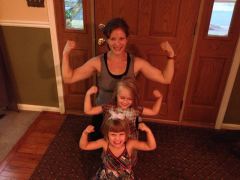
strong pic

I have a confession to make. I’ve never been completely happy with my appearance. What woman has? (Maybe Tootsie?)

“I’ve never been completely happy” is actually a mild way of putting it. I’m pretty hard on my reflection. It would make my husband crazy. I’d look in the mirror and go, “Ugh, look at this ponch on my belly. With the stretch marks it’s like a deflated balloon.” He’d try to reassure me, and I’d just cross-examine him like some vicious defense attorney.

Me: I hate my hair.

Him: What do you mean? You look beautiful.

Me: Are you really looking at my hair?

Him: Of course.

Me: You can’t see all this friz? Admit it, my hair looks frizzy.

I know I’m not alone in this. I’m friends with dozens of beautiful women. Women whose faces are some of the loveliest things I’ve ever seen. I honestly don’t have one unattractive girlfriend. But I can only think of a small handful whom I’ve never heard disparage their own bodies.

And why? Why can’t they see their own beauty which looks plainly obvious to me? Why can’t I see my own? There are those impossible beauty standards we see in magazines and advertising. But I don’t think it ends there. There seems to be some gene inherent in all womankind that makes us think, “the normal way to feel is to hate my body.” It’s passed from seventh-grader to sixth-grader and mother to daughter. (Not my mom, though. Maybe because she’s so pretty. ;) Thanks mom!)

Mom and Emma

My mom with my daughter, Emma

So, a couple of years ago, I decided I was going to change the way I think about my body for two reasons. Emma and Sophia. I’ll be damned if I’m going to pass on my self-loathing to my daughters.

I started off just trying my best to refrain from making negative comments about myself in front of them. And let me tell you, it hasn’t been easy. If they’re awake, they’re listening to me. (Well, not listening per se, but they’re hearing me, anyway.) They could be chasing each other around the house or completely absorbed in their favorite book, but if I even mutter something under my breath, they’ll go, “What did you say, Mommy?”

Me: (Silence)

Girls: Mommy! I said, ‘What did you say?!’

Me: Nothing girls, I was talking to myself.

Girls: But what did you say?! Tell me, Mommy! TELL ME!

There have been so many times that I’ve caught myself squeezing my belly flab in the mirror, and just before I bust out an, “Ugh, I’m so fat!” I notice one of them playing nearby, and I shut up.

I’ve been working hard to lose weight since my third baby was born (my son, Raymond), which has meant a lot of exercising and dieting. I present it to the girls as trying to be healthier. Exercise is good for you. Fruits and vegetables are good for you. A crap-load of sugar and fat? Not good for you. (I didn’t say no sugar and fat at all. Just keep it under a crap-load.)

Sophia likes to do my work out videos with me. One day she was in my room while I was changing into my exercise clothes. So far I’d gotten on my stretchy pants and my sports bra. She looked up at me with big ole baby doll blue eyes, wide as the ocean, as if she’d just seen the most fantastic Christmas present delivered directly to her hands by Santa Clause himself. “Mommy. You should just wear that without your shirt so you’ll look like Jillian Michaels in week 3.”

It took every ounce of willpower I had not to respond, “Honey, I look absolutely nothing like Jillian Michaels.” The words came to my mouth and stopped just short of my lips. I looked down at my stretch-marked stomach, and I said, “Hmm. You think I look like Jillian Michaels in this?”

She nodded, eyes still wide. Well, it’s not like I was going to the gym. I was working out in my own living room. Nobody could see me but my Sophia. So I figured, what the hell? I’ll do it for her.

That day I discovered something. A “fake it til you make it” approach to self-confidence. I started making a conscious effort not only to refrain from hating myself in front of them, but to say positive stuff about myself in their presence as often as possible. “Doesn’t Mommy look pretty in this dress?” “Look how strong my muscles are.” “Don’t you loooove my new haircut?”

After several months of trying to convince my daughters that I loved the way I looked, I actually started to convince myself. I won’t lie. Losing weight has helped a lot. I’ve lost 35 pounds since I started that fitness and dieting kick I was talking about. But honestly, I’ve been this thin before. I’ve been thinner than this. And I’ve always thought I was fat. Not anymore.

I used to look at other women and think things like, “I love her outfit, but I’d look terrible in it.” Now I think, “I bet that dress would look great on me.”

There is still that little evil voice in my brain that jumps out every now and then to remind me of my cellulite and love handles. I’m not in punch drunk love with myself. I’m just better at smothering the little demon before he does too much damage.

And look, I’m not saying there’s anything wrong with wanting to lose weight, get clearer skin, de-friz your hair or anything else women try to make themselves prettier. I’m just saying, do we have to hate ourselves in the mean time? Because I’ll tell you a secret. If you think you’re fat, ugly, frizzy, zitty, whatever, there is no one who is harder on you than you are on yourself. (No normal person, at least. If you’re close to some jerk who says you’re ugly, please do me a favor and kick said jerk in the butt, take pictures, and send them to me.)

But seriously, start telling someone that you’re beautiful. If you don’t have daughters, tell your husband. Tell your boyfriend. Tell your mom. Tell your sister. Pick something good about your body that you can say with a straight face, run straight to your best friend, and say it. My butt rocks in these jeans. Doesn’t this color bring out my eyes? Check out this dress I bought for my cousin’s wedding. I look gorgeous in it!

Just fake it til you make it. I promise, it feels much better to love the way you look.

Do you have any tricks to build your self-confidence? Let me know in the comments section below. I’d love to hear from you!

I Think My Children May Have Stolen My Brain

Nicole glasses

Do you think an unborn child can suck her mother’s brains out through the umbilical cord? I realize this sounds “scientifically impossible,” but hear me out.

I used to be pretty smart. OK, I shouldn’t be so modest. I was kind of a super brain. (My mom will back me up on this.) Now, I don’t want to get braggy or anything, but I have a Master’s Degree. And I used to hold some important jobs.

When I was a Social Worker, I could recite the portion of the Code of Maryland Regulations that pertained to treatment foster care, practically word for word. I could tell you family history, diagnosis, and recommended treatment for any one of my clients without looking at their files. And I came up with some pretty brilliant ideas in their treatment plans, if I do say so myself.

As an HIV/AIDS Policy Analyst (Senior Policy Analyst, mind you), I was always familiar with all the newsy, wonky stuff going on in HIV Prevention. I understood the nuances behind important-sounding stuff, like The Centers for Disease Control and Prevention’s “Advancing HIV Prevention: New Strategies for a Changing Epidemic.” I wrote papers and presented them at conferences. I attended national strategic policy meetings and people asked me for my opinion. For crying out loud, there were actual professional smart people who sought me out to give a guest lecture to a public health class at Johns Hopkins University and a keynote address at a state-wide public health conference in Nevada. And I’m not even from Nevada!

I’m not saying all this to impress you with my brilliance. Just to draw a contrast. Because, see, I’m not sure I could do any of that stuff anymore. Today I’m lucky if I both get to my daughter’s school for pick up without getting lost and drive us all home to the right house.

Yesterday, I went to the gym to squeeze in a quick workout while my big kid was at school. I dropped the little ones in the gym’s babysitting room and took a look at the kid’s fitness schedule for the day. (My gym has awesome fitness classes for toddlers.) The 2-year-old class was just about ready to start, so I signed Raymond up. The 4-year-old class wasn’t for another hour and a half, so I figured Sophia was out of luck for today. A little while later, Angie, the kid’s fitness instructor, came up to a woman who was working out next to me and said she was going to take her kid to the 3-year-old class that was about ready to start, because nobody else had signed up for 4-year-olds. I said, “Oh, great! Can you take Sophia too? I didn’t sign her up because the 4-year-old class was so late.” Angie said, “Sure.” A few minutes later, Angie came back and said, “Nicole, I love you, but I think you may be losing your mind.” And surely I am, because I didn’t bring Sophia to the gym that day. I dropped her off at pre-school. Right before I came to the gym. I dropped her off, drove to the gym without her, looked at a class list, and felt sorry that she couldn’t go. Yes, I am losing my mind.

And my poor dog. I frequently let her out for a quick pee before the kids and I head off to school or shopping or the park or wherever, and then just completely forget to let her back in. (Lucy is not a dog that likes to hang outside by herself, mind you.) And when my husband is out of town, I’ve been known to forget to feed her for up to a day and a half.

I once saw an episode of Dr. Phil about some condition called Momnesia. (This is a real thing, I swear!) They had a new mother on who kept doing absent-minded stuff like leaving the door to the fridge open and forgetting how many scoops of formula she’d put in the bottle so far. I was like, “That’s me! I have Momnesia! Help me, Dr. Phil!” Unfortunately, Dr. Phil said that Momnesia only lasts up to 6 months. I’ve had it for 5 1/2 years. I’m running out of excuses.

This brings me back to my original thesis, that my children have stolen my brain. Let’s review the evidence. Before kids, I did a bunch of really smart stuff. After kids, I can’t find my own house or remember what I did 15 minutes ago.

Plus, my kids are really smart! I know they stole my brains, because all that smart stuff I used to think seems to have transferred itself to the insides of those tiny little heads. (Or in Raymond’s case, that humongous head that I’m very proud of birthing.)

Here is an actual, not-made-up conversation that took place in my house:

Me: Did your butterfly hatch from its cocoon yet?

Emma: It’s called a crysalis.

Me: Butterflies don’t hatch from cocoons?

Emma: Cocoons are for moths. Butterflies come out of a crysalis.

Sophia glasses 3

Emma and Sophia reading

Emma and Sophia reading

Plus, Sophia started reading just a few months after her 3rd birthday, and Emma could read at 4 1/2.

Not just children’s books either. They can read signs, instruction manuals, history books, the Bible, nutrition labels. This is Sophia when I told her she could choose one box of cereal. She wanted to make sure it didn’t have too much sugar.

Sophia nutrition label

And here’s 2-year-old Raymond when I found him with one of those outlet cover plugs in his hands: “It’s choking hazard, Mommy. Don’t put in your mouth.” Thanks, bud. I’ll keep that in mind.

Of course, since he’s the third kid, there may not have been as many brain cells left for him to suck out, because he also did this to his head:

Raymond head in gate

That may also be because my husband does this to him:

Just a little beer

Just a little beer

But you know, now that I think about it. I am the one who taught them how to read. Sophia didn’t just start checking nutrition labels one day. She learned it by watching me. And Raymond would have no idea what a choking hazard was if I weren’t constantly telling him to keep them out of his mouth. Plus, I am becoming quite versed on child development and emergency room procedures (that’s another story).

If nothing else, I’ve produced three pretty smart kids. The world needs more of those.

Do you have any Momnesia moments to share? Please let me know in the comments section. I’d love to hear from you!

This Is Why I Love Southern Fiction…

Where else can you find opening lines like these ones from my writing idol, Joshilyn Jackson:

From A Grown Up Kind of Pretty:

I never would have known about the other Mosey Slocumb if Tyler Baines hadn’t brought his mullet head and a chain saw over to murder my mom’s willow tree. I wouldn’t have bet someone else’s dollar that Tyler Baines, of all people, would be the one to discover her. Tyler Baines was not the discovery type. He was more the patchy-chin-pubes, tats, dirty-white-truck type. He was totally hooked on Red Man, too, so he spewed brown juice like a cricket everyplace he went. Last year my mom nicknamed him the Mighty Un-Butt Crack, because she said he was a single flash of ass plumage away from being the walking definition of a redneck.

And from Gods in Alabama:

There are gods in Alabama: Jack Daniel’s, high school quarterbacks, trucks, big tits, and also Jesus. I left one back there myself, back in Possett. I kicked it under the kudzu and left it to the roaches.

What are your favorite opening lines from novels? Let me know in the comments section below. I’d loooove to hear from you!